
Power × connection
Bullying
21 licensed clinicians · Orem & Murray · statewide telehealth
How RDX Works
RDX — The RDX Effect — is the implementation layer between what policy asks for and what staff do in a hard interaction. Your staff, your leaders, and the people you serve get the same words. No software. We come to your site.
Funding and policy do not automatically change what staff do in a difficult family interaction. When morale drops, it shows up as turnover, conflict, and uneven care. Most of what gets called dysfunction is a system rebalancing itself in a costly way. RDX gives the room one map so people work on getting it right rather than being right.
Power and vulnerability. Connection and disconnection. A twelve-year-old and a shift supervisor can use the same words.
Power
Vulnerability
Connection
Disconnection
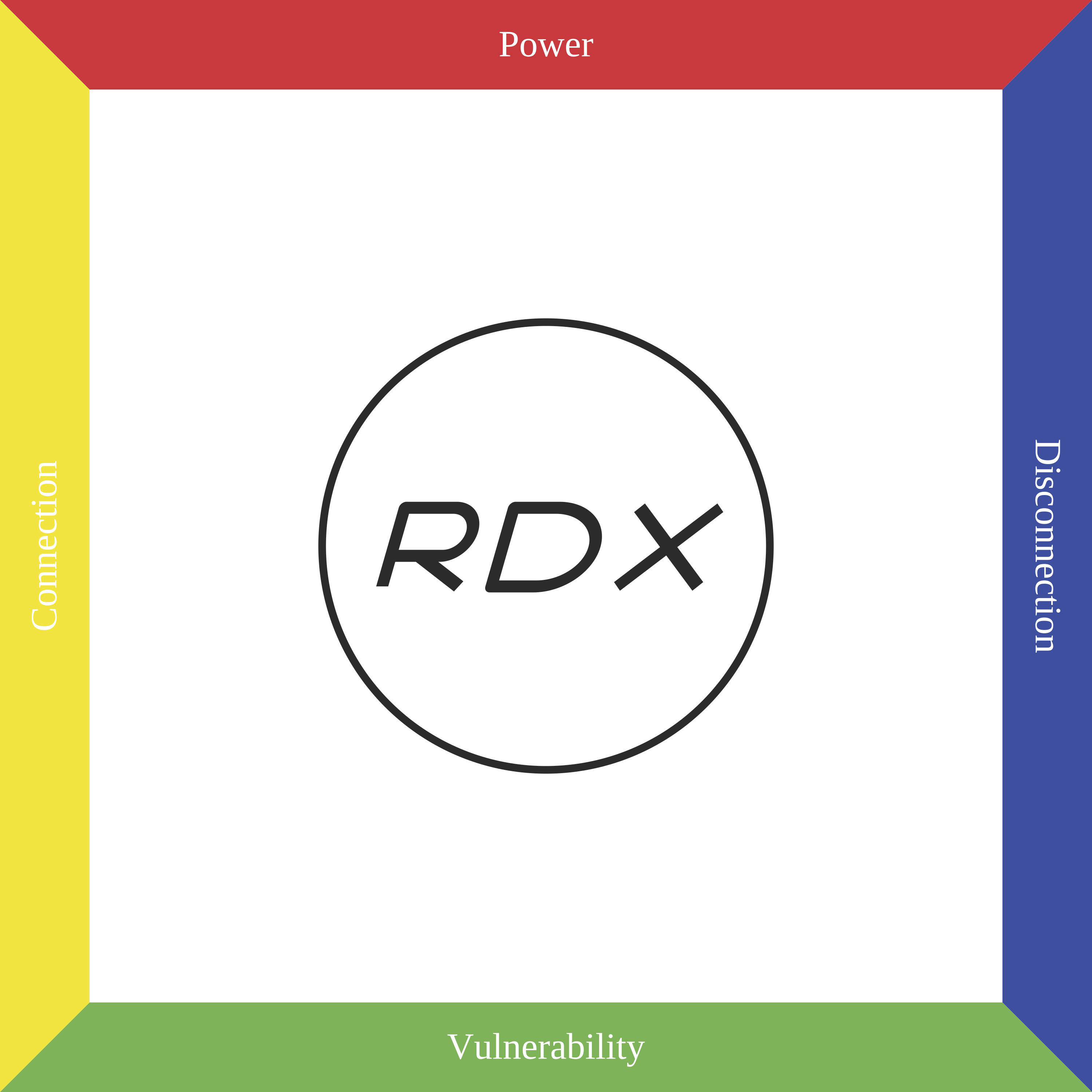
Anyone can visit a corner. Trouble starts when a position hardens into a role.
Power × connection
Bullying
Power × disconnection
Defiance
Vulnerability × connection
Neediness
Vulnerability × disconnection
Shutdown
No good, no bad. Only balance.
Fixed or fluid. The inability to move is the problem — not any position.
Taught standing up. On a mat, at your site. It works for people who will never sit on a couch.
Staff rehearse the same four moves until they become the way the work gets done — engage, de-escalate, set a boundary, choose a safe next action, document, refer, and follow through.
01
Identify the system, the pressure, the distress, and the repeating interaction.
02
Use shared, non-blaming language for power, vulnerability, connection, and disconnection.
03
Rehearse one safe, practical movement — a boundary, a request, a pause, a connection, a separation, or a support action.
04
Turn insight into a next step, documentation, a warm handoff, follow-up, and a success measure.
Same two scales. Same words. Three rooms in your organization.

Teachers, case managers, peer specialists, and advocates — a shared language for what the work does to them.

Role fit, burnout, and live disputes. Supervisors keep the refer boundary.

Families, youth, and groups who will never book a therapy appointment. Same map as the people who serve them.
Same model. The rooms you already use. Classroom · Conference room · Gym · Clinic · Community room · Living room
A Q4 micro-purchase puts RDX in the room so you can see the practice. A longer pilot is how you install it as a repeatable quality system. Start with the smaller ask.
It usually hits lines you already have: staff development, staff wellness, mental health consultation, or contractual and professional services.
Every offer is scoped under the federal micro-purchase threshold — one quote, no competitive solicitation, a purchase order rather than an RFP.
When someone is stuck, Connections’ RDX-trained clinicians take it from there — same language on both sides of the handoff.
Anyone who is not a licensed clinician learns a bounded role. When someone is stuck, Connections’ RDX-trained, trauma-informed clinicians take it from there.
About RDX and ConnectionsEach Q4 offer is a fixed-scope micro-purchase — one quote, no formal procurement. Use it to put the model in the room, then decide if a longer pilot is next.
See the offers